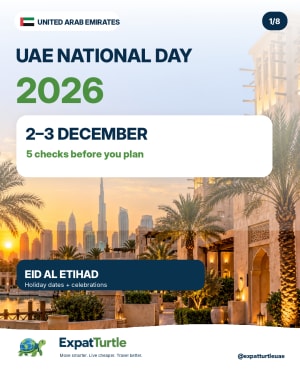

Photo by Kate Trysh on Pexels. Taken in Dubai, UAE.
UAE · First 30 days · Last verified October 1, 2026
Your first month in the UAE is easiest when you separate federal residency/identity tasks from emirate-specific housing and utility tasks. A practical sequence for many new residents is residence processing → medical fitness where required → Emirates ID → UAE PASS → local mobile line → bank account → health-insurance confirmation → housing/utilities.
Your first-month priorities
- Complete the residence-permit process and linked Emirates ID application.
- Complete the required medical-fitness screening for your residence/work category.
- Set up and verify UAE PASS for digital government services.
- Register a local SIM/eSIM under your Emirates ID once you are a resident.
- Open a UAE bank account after your core identity/residency documents are available.
- Confirm that your health-insurance coverage is active and appropriate for your emirate/employment situation.
- Arrange tenancy registration, electricity/water and housing services using the rules for your emirate — Dubai and Abu Dhabi do not use the same systems.
Days 1–7: complete residence and Emirates ID processing
ICP’s federal residence service states that issuing a new residence permit is linked to an Emirates ID card application. The residence process and Emirates ID are therefore not two completely separate newcomer tracks.
The exact route depends on your sponsor and residence type — for example employment, family sponsorship, investor, student or self-sponsored residence. Dubai applicants can also encounter GDRFA-specific service channels, while ICP handles federal residency services outside the Dubai-specific system.
Applying for your Emirates ID? Read our Emirates ID guide for new UAE residents for application steps, biometrics, fees and delivery.
Complete medical fitness where required
UAE government guidance says expatriates applying to work or live in the UAE undergo medical testing as part of residence procedures. The required screening can depend on the worker category and emirate.
Do not book an arbitrary private check-up and assume it satisfies residency rules. Use the approved medical-fitness route shown for your application/emirate.
Week 1: set up UAE PASS
UAE PASS is the UAE’s national digital identity for citizens, residents and visitors. It is used to access digital government and private-sector services, sign/verify documents and share issued digital documents.
Once your identity details are available, set up UAE PASS early because it reduces repeated logins and identity checks across many services. Our UAE PASS guide covers registration and verification.
Week 1: switch to a resident local SIM or eSIM
TDRA says citizens and residents use Emirates ID as the official identity document for mobile subscriber registration. Registration rules apply to voice and data SIMs, including eSIM-based local subscriptions.
If you started with a visitor SIM or travel eSIM, compare whether it is worth moving to a resident prepaid/postpaid UAE line once your Emirates ID is ready. A local number is useful for banking, landlords, deliveries and government-service verification.
See our UAE mobile plans guide and travel eSIM vs local SIM guide.
Week 1–2: open your UAE bank account
Once your residence and identity documents are in place, compare banks based on the actual account conditions you need. Requirements vary by bank and product, but resident onboarding commonly depends on passport/residence/Emirates ID information and may also use employment or salary evidence for particular account types.
Do not choose only by the welcome offer. Compare minimum-balance rules, monthly fees, salary-transfer requirements, ATM access, international transfer costs and what happens if your employment status changes.
Our UAE bank-account opening guide covers onboarding, while our UAE bank-fees guide covers fee comparisons.
Confirm your health insurance is active
Health-insurance obligations are now broader than the old “Dubai and Abu Dhabi only” shorthand. MOHRE states that, from 1 January 2025, the UAE extended mandatory health-insurance coverage for private-sector employees and domestic workers across all emirates, with the employer/employer of the domestic worker responsible for the required policy when issuing or renewing residency under the applicable system.
Dubai and Abu Dhabi retain their own local health-insurance frameworks, while the federal basic scheme covers the other emirates for the targeted private-sector/domestic-worker groups. Dependants and self-sponsored residents can have different responsibilities, so confirm your exact policy rather than assuming your employer’s coverage automatically includes your whole family.
Week 1–3: housing — use the correct emirate system
Housing administration is not one UAE-wide process. Dubai commonly uses Ejari for tenancy registration and DEWA for electricity/water, while Abu Dhabi uses Tawtheeq and its own utility ecosystem. Other emirates have their own authorities/providers.
Before paying deposits or setup fees, identify which emirate authority is responsible for your address. Never follow a Dubai checklist just because you live elsewhere in the UAE.
Week 2–4: finish the practical setup
- Arrange home internet where required.
- Update payroll/bank details with your employer.
- Save digital copies of passport, residence permit and Emirates ID.
- Check driving-licence rules before relying on a foreign licence as a resident.
- Set up official apps/accounts you actually use rather than downloading every government app at once.
- If you sponsor family, track their separate residence, ID and insurance steps.
Your 30-day checklist
- Complete residence-permit processing.
- Complete approved medical fitness if required.
- Receive/activate Emirates ID.
- Set up and verify UAE PASS.
- Move from visitor connectivity to a resident SIM/eSIM if appropriate.
- Open the right bank account for your salary/balance profile.
- Confirm health-insurance coverage.
- Register tenancy through the correct emirate system.
- Set up utilities/internet.
- Check driving-licence requirements.
- Keep all official receipts and digital confirmations together.
Official sources checked
- ICP — Issuing Residency Permit
- UAE Government — Health conditions for residence
- UAE PASS — About the national digital identity
- TDRA — Mobile subscriber registration
- MOHRE — Basic Health Insurance Scheme
Verification date: October 1, 2026. UAE residency, health insurance, tenancy and utility processes depend on sponsor, residence type and emirate. Dubai-specific procedures are not automatically UAE-wide.
← UAE hub · More moving guides · UAE PASS · UAE bank account · How we research